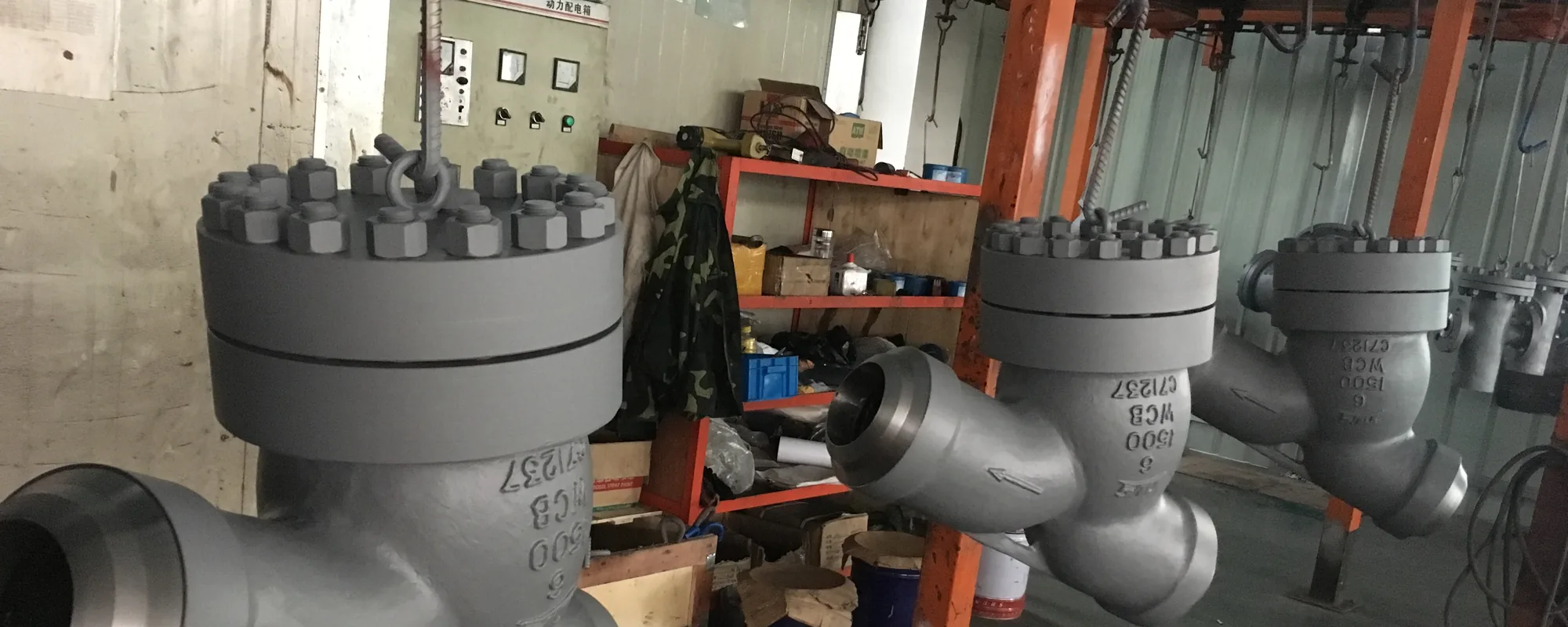
“Forged” appears on almost every Chinese valve export site, and on a lot of them it means very little. It is worth being precise about what forging actually gives you, where it genuinely matters, and where a good casting is the better engineering answer.
What forging actually changes
In a casting, the metal solidifies in the mould. The grain structure is whatever the solidification produced, and any shrinkage that occurred as the metal cooled stays as porosity - concentrated in the thickest sections, which in a valve body means around the seat pockets and the neck.
In a forging, the metal is worked while hot. The grain flow follows the deformation, so it runs along the contour of the part rather than being randomly oriented, and the working closes up the voids present in the starting billet.
Two consequences matter for valves:
Directional strength where the load is. In a forged body the grain flows around the seat pocket and up the neck, which is the direction the stress runs. This shows up in resistance to crack initiation under cyclic loading rather than in the tensile test results.
No shrinkage porosity in thick sections. This is the practical one. A Class 2500 body has substantial wall thickness. If porosity is present, it is found by radiography - after most of the machining has been paid for, if it is found at all.
Where forging is clearly the right answer
- Thick-wall, high-class bodies. Class 1500 and 2500, particularly in the smaller and mid-range bores where a forging of the required section is readily available.
- Creep-grade materials. F91 and F92 are demanding to cast well. Forged product is the norm and, in many specifications, mandatory.
- Cyclic duty. Units that two-shift see far more thermal cycles than the original design assumed. Crack initiation resistance is worth paying for.
- Small-bore valves. Below NPS 2 forging is simply the normal manufacturing route for compact valves under API 602.
Where casting is the better answer
This is the part most supplier sites omit.
- Large bore, complex geometry, moderate class. A large globe body with an internal web is far more economical to cast than to machine out of a forging, and at moderate class the wall thickness does not put you in the porosity-risk regime.
- Where the specification calls for cast. Some client specifications name A216 WCB or A217 WC6/WC9 explicitly. Forged is not automatically an acceptable substitution - it is a change, and it needs to be approved as one.
- Where the forging is not available. A grade and section that no mill can supply on the project schedule is not a solution, however good the metallurgy.
A properly specified, properly inspected casting in the right application is not a compromise. Treating “cast” as a synonym for “cheap” is how projects end up over-specifying forgings on duties that never needed them.
The terminology problem
These terms are used loosely, and the looseness is sometimes deliberate:
Cast - poured into a mould. The usual ASTM specifications for cast valve bodies are A216, A217 and A352.
Forged - hot-worked from a billet. Material specification for alloy grades is typically ASTM A182.
Open-die forged - worked between flat or simple dies, with the operator manipulating the piece. Suits large sections and one-off geometries. Leaves more machining allowance.
Closed-die forged - pressed into a shaped die cavity. Better dimensional consistency, less machining, worthwhile only on repeat quantities.
One-piece forged body - the pressure-containing body is machined from a single forging, with no welded pressure-boundary seams.
Integral forged - a specific feature is formed as part of the same forging rather than welded on. An integral seat means the seat is part of the body forging. An integral end connection means the flange or weld end is not a separate welded-on piece.
The last two are the ones that get conflated. They are not synonyms. A one-piece forged body can still have a welded-in seat ring. If your specification asks for integral seats, it is asking for something specific, and a supplier answering with “one-piece forged” has not answered.
How to write the requirement
Vague: “Valve body shall be forged steel.”
That is satisfied by a body machined from a forging with a welded-on flange, an inserted seat ring, and no statement of the forging route.
Better:
Pressure-containing parts (body and bonnet) shall be manufactured from forgings to ASTM A182 Gr. [grade]. Welded seams in the pressure boundary are not permitted. Seat rings may be welded-in, and the welding procedure and PWHT shall be submitted for approval. The forging route (open-die or closed-die) shall be stated on the datasheet. Forgings shall be ultrasonically examined prior to machining to [acceptance standard].
That version is checkable at inspection. The vague one is not.
What to ask for
- The forging route, per item, on the datasheet
- The mill certificate for the forging, traceable to the heat
- The UT report from before machining
- Heat treatment charts for the forging, and separately for any PWHT
- A clear statement of which parts the forging requirement covers
If a supplier cannot produce the pre-machining UT report, they did not do it, or they did not do the forging.