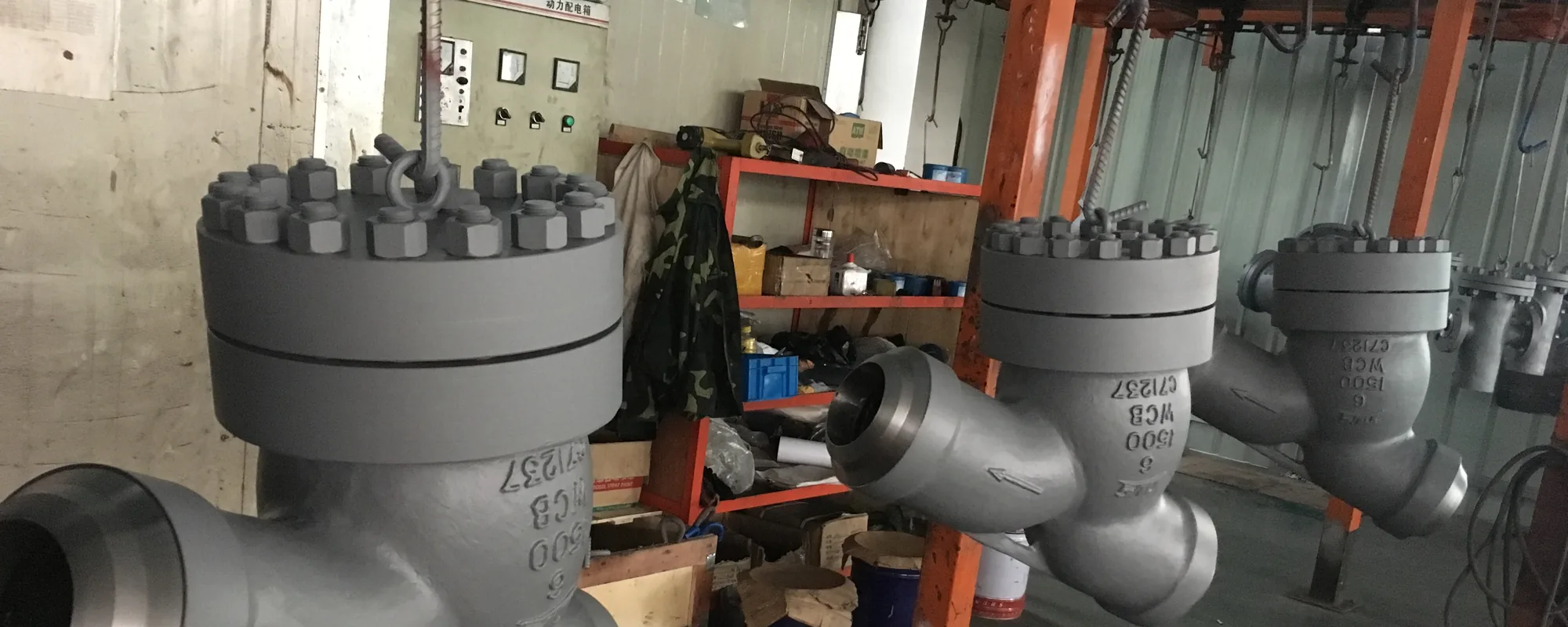
Severe service valves
Severe service is not a marketing adjective. It describes duties where the failure mechanism is something other than static pressure: high differential pressure across a partially open closure member, entrained solids or wet steam eroding the seating surfaces, thermal transients driving fatigue in the body crotch, or cycle counts high enough that wear rather than rating governs the life. These duties need the construction chosen against the mechanism, and they need the conditions defined before anything is quoted.
- Governing mechanism
- Differential pressure, erosion, fatigue, cycling
- Valve types
- Gate, globe, check, stop-check
- Pressure rating
- Class 900 - 4500
- Temperature
- to 650 °C
- Trim
- Stellite 6, hardfaced, nickel alloy
- Scope
- Engineered per duty
Product range
This is a service category: it describes a duty rather than a construction, and the valves that answer it are published under the construction that defines them. The selection table, materials and standards below apply to all of them.
Design against the mechanism, not against the rating
A valve that is correctly rated can still fail quickly if the wrong mechanism was considered. High differential pressure across a partly open wedge erodes the seat, which is why throttling on a gate valve destroys it. Wet steam and entrained particles cut hardfacing at the point of highest velocity, which moves the design question to trim geometry rather than trim hardness alone. Rapid thermal transients concentrate strain in the body crotch, which makes forging route and wall transition geometry the controlling variables. Frequent cycling turns packing and seat contact into consumables, which changes the maintenance interval and therefore the correct construction.
Design features
Trim geometry chosen against the flow
Where erosion governs, the answer is where the energy is dissipated, not simply a harder overlay on the same profile.
Two-layer hardfacing
Stellite 6 applied in two layers so the finished surface is not diluted by the parent material, then machined to the final seating profile.
Wall transition detailing for thermal fatigue
Generous radii and controlled section change through the crotch, which is where a start-up thermal gradient concentrates strain.
Live-loaded packing for cycling duty
Belleville stacks maintain gland load as packing consolidates, so stem sealing survives cycle counts that would otherwise need repeated adjustment.
Stated design basis
The mechanism the valve was designed against is written down, so the operating limits are explicit rather than implied by a rating table.
Selection table
A first cut at gate, globe, check or stop-check. The values are catalogue ranges, not a commitment for a specific item.
| Product type | Body | Class | Temperature | Typical service |
|---|---|---|---|---|
| Anti-erosion globe valve | Forged | 900 - 2500 | to about 620 °C | Wet steam, entrained solids, high pressure drop |
| High-pressure drain valve | Forged | 1500 - 4500 | to about 400 °C | Continuous and intermittent drain, high differential |
| Thermal cycling gate valve | One-piece forged | 1500 - 4500 | to about 650 °C | Two-shifting and peaking units |
Materials
The grade is selected against the rating at your design temperature. The full matrix, with the reason each grade exists, is on the material matrix page.
| Material | Typical service | What decides whether it is right |
|---|---|---|
| A105 / F36 | General high-pressure steam and water | Forged carbon steel. Cheap and well understood, but it loses allowable stress quickly with temperature, so it has to be checked against the rating table rather than assumed. |
| F22 / WC9 | High-temperature steam | Chromium-molybdenum. The workhorse above the carbon steel limit, with useful creep strength and straightforward welding compared with the martensitic grades. |
| F91 / C12A | Supercritical steam | Modified 9Cr-1Mo. Much higher creep strength, but only if the heat treatment window was held. The furnace and PWHT charts are the evidence that it will perform, not the grade name. |
| F92 | Ultra-supercritical steam | Higher creep strength again at the top temperature and class combinations, with a narrower processing window than F91 and correspondingly less tolerance for error in heat treatment. |
| WB36 | High-pressure feedwater | High-strength low-alloy steel used where feedwater pressure rather than temperature governs, allowing a thinner wall than a carbon steel equivalent at the same class. |
| F347 | High-temperature corrosive media | Stabilised austenitic stainless. Selected for corrosion resistance and for stability against sensitisation, not primarily for creep strength. |
Applications
- Boiler blowdown and high-pressure drains
- Turbine bypass and startup vent
- Coal gasification: particulate-laden, abrasive service
- Refining: hydrocracking and FCC severe positions
- Any unit that two-shifts or peaks rather than running base-load
Standards and testing
Listed only where the standard actually governs something on these valves. What each one covers on a specific item is stated on that item's page.
Downloads
Catalogue, datasheets, material guide, pressure-temperature rating tables and the RFQ datasheet are collected in resources. Files carry a version date and use searchable text rather than scanned images.
Frequently asked questions
What do you need before quoting a severe service valve?
The medium composition including entrained solids or moisture, the differential pressure across the valve when it is throttling, the transient profile, and the expected cycle count. Without those, any quotation is a guess dressed up as a specification.
Can a standard catalogue valve be uprated for severe service?
Sometimes, by changing trim material and seating geometry. Often not, because the mechanism is in the body rather than the trim. We will tell you which case applies rather than sell a trim change that will not survive.
Do you carry out qualification testing?
Where the project requires it, as engineered scope priced separately. Flow testing, cycle testing and thermal cycling qualification are real cost and schedule items, and they are quoted as such rather than implied.
Related
Ask for a quotation
Send a valve list and we answer line by line, including the lines where we would need a deviation and the lines where we think the wrong valve has been specified.