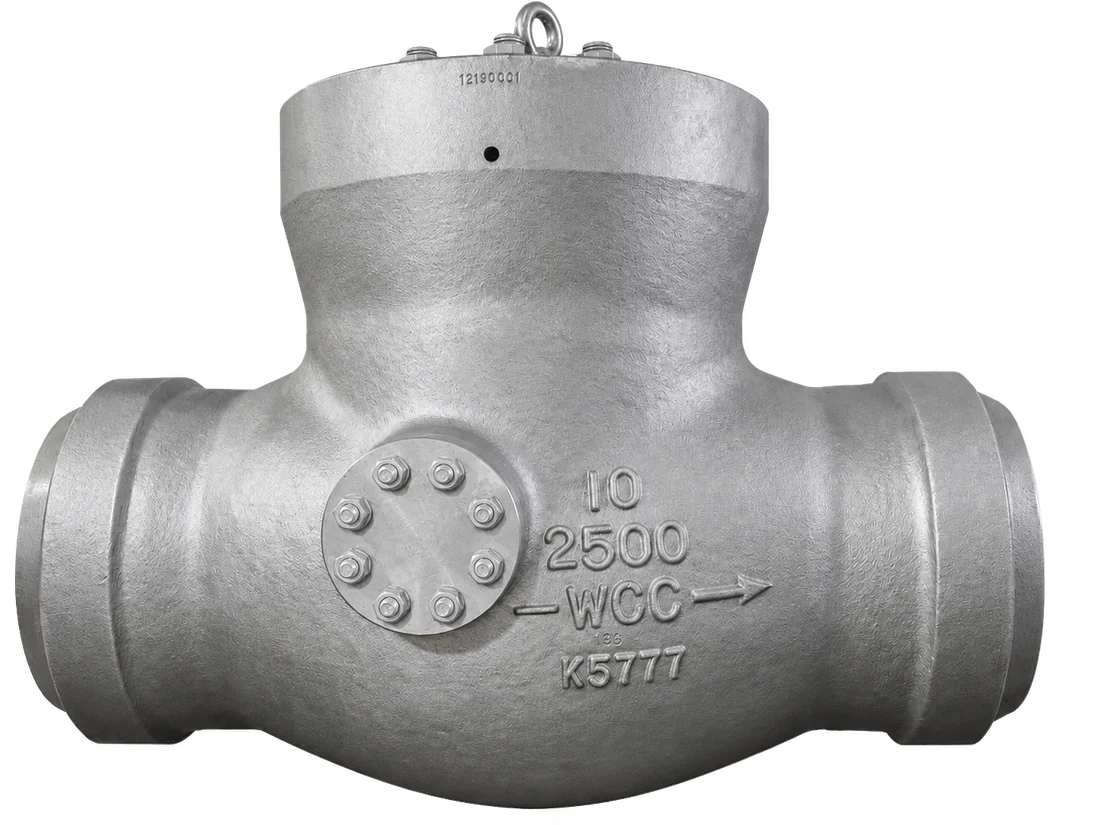
Dervos valve · Product specification
Forged Check Valve
Check valves with a one-piece forged pressure boundary for power station duty, in both pressure seal and bolted cover arrangements depending on class.
- Size
- NPS 1/2-24 (DN 15-600)
- Pressure class
- Class 150-2500
- Body material
- A105, A182 F11, F22, F91, F92, F304/F316 for auxiliary
- End connection
- SW, NPT, BW, flanged RF or RTJ
Catalogue ranges for initial selection. Final rating and configuration are confirmed against your project specification.
Have an MTO or datasheet? Send it with size, class, material, quantity and required delivery.
01 / Selection data
Technical specifications
Use these ranges to shortlist the valve. Values marked “confirm per order” depend on the selected size, material or project standard.
Swipe or scroll sideways to view the full table.
| Parameter | Specification | Basis |
|---|---|---|
| Size | NPS 1/2-24 (DN 15-600)Small bore below NPS 2 follows API 602 construction. | Catalogue range |
| Pressure class | Class 150-2500 | Catalogue range |
| Cover type | Bolted to Class 600, pressure seal from Class 900 | Catalogue range |
| Design temperature | up to 650 °C / 1200 °F | Configuration dependent |
| Body material | A105, A182 F11, F22, F91, F92, F304/F316 for auxiliary | Catalogue range |
| Body construction | One-piece forged pressure boundaryWe state per size which features are integral to the forging and which are welded. | Catalogue range |
| Type | Swing, piston lift, ball check (small bore) | Catalogue range |
| End connection | SW, NPT, BW, flanged RF or RTJ | Catalogue range |
| NDE scope | UT or RT on the forging, MT/PT on machined surfaces | Confirm per order |
02 / Engineering
Valve design & materials
One-piece forged pressure boundary
Body machined from a single forging. Grain flow follows the contour of the part instead of being interrupted, and there is no shrinkage porosity in the thick sections around the seat. On thick-wall Class 1500 and 2500 parts this is the main technical argument for forging over casting.
Class-appropriate cover arrangement
Bolted cover below Class 900 because it is simpler to maintain and adequate for the duty; pressure seal above, because bolt load alone cannot hold the joint through repeated thermal cycles. We do not fit a pressure seal cover to a Class 300 valve to make the datasheet look better.
API 602 small-bore construction
Below NPS 2 the valves follow API 602 rather than API 600 - different wall thickness basis, different end connection set. Getting this right matters when the valve goes on an instrument or drain connection covered by the piping class.
Traceable material through the whole boundary
Each pressure-containing part carries the heat number through machining to final assembly, and the heat numbers on the MTC match the parts in the valve. This is checked at final inspection, not assumed.
Reference material configurations
Material combinations are examples for selection; the final bill of materials is agreed for each order.
Swipe or scroll sideways to view the full table.
| Part | Carbon steel | Alloy steel | F91 / F92 |
|---|---|---|---|
| Body | A105 / A105N | A182 F11, F22 | A182 F91, F92 |
| Seat ring | 13Cr + Stellite 6 | 13Cr + Stellite 6 | F91 + Stellite 6 |
| Disc | A105 + Stellite 6 | F11 / F22 + Stellite 6 | F91 + Stellite 6 |
| Hinge arm | A182 F6a | A182 F6a | A182 F6NM |
| Hinge pin | A182 F6a, hardened | A182 F6a, hardened | A182 F6NM / Inconel 718 |
| Bushing | Stellite 6 / hardfaced | Stellite 6 / hardfaced | Stellite 6 / hardfaced |
| Cover (bonnet) | A105 / A105N | A182 F11, F22 | A182 F91, F92 |
| Cover plug / vent | A105 | A182 F11 / F22 | A182 F91 |
| Nameplate | AISI 304 | AISI 304 | AISI 304 |
Service fit
Where this valve is used
Typical applications
- Feedwater pump discharge and recirculation
- Boiler circulating pump discharge
- Superheater and reheater drains
- Auxiliary and gland steam
- Small-bore instrument and sampling lines (API 602 sizes)
Selection limits to check
- Use as an isolation valve. It has no positive shut-off function.
- Duties where a cast body is explicitly specified and no deviation is permitted - forged is not automatically an upgrade in a client specification.
- Very large bores where a forging of the required section is not economically available; above roughly NPS 24 this becomes project-dependent.
Quality assurance
Inspection & delivery documents
The inspection and test plan defines the agreed scope, hold points and witness points for your order.
Inspection scope
- Hydrostatic shell test to API 598 / MSS SP-61
- Hydrostatic or pneumatic seat test, leakage rate per specification
- Back seat test (gate and globe, where a back seat is supplied)
- PMI on all pressure-containing parts and welded overlays
- NDE per specification - RT, UT, MT or PT as applicable
- Hardness survey after post-weld heat treatment
- Dimensional inspection against approved GA drawing
- Material certification EN 10204 3.1 (3.2 on request)
- Visual and functional check, full stroke on the manual operator
Document package
- Product datasheet
- General arrangement (GA) drawing
- Inspection & Test Plan (ITP)
- Material test certificate (MTC) EN 10204 3.1
- Hydrostatic and seat test report
- PMI report
- NDE reports as applicable
- Heat treatment charts
- Dimensional report
- Packing list and preservation record
Reference framework
Applicable standards
Pressure-temperature ratings, materials, wall thickness, testing and marking. This is the base rating standard for the valve - it is what fixes the allowable pressure at your design temperature.
Face-to-face and end-to-end dimensions. Relevant when the valve replaces an existing one or has to drop into a fixed spool.
Compact steel valves NPS 4 / DN 100 and smaller. Applies to the small-bore end of this range only - it is not the design basis for the large sizes.
Butt welding end preparation, including bore and bevel geometry for the matching pipe schedule.
Inspection and pressure testing - which tests are mandatory, test durations and allowable leakage. We state the shell and seat test scheme on the ITP.
Marking of the body and the nameplate - size, class, material heat, figure number and flow direction where applicable.
Buying questions
Frequently asked questions
Is a forged body always better than a cast body?
For thick-wall, high-class, thermally cycled service, forging gives better grain structure and avoids casting porosity. For large-bore, complex-geometry, lower-class valves a good casting with proper NDE is entirely appropriate and usually cheaper. What matters is that the choice is made against the duty and stated on the datasheet - not that one is universally superior.
What NDE do you apply to the forging itself?
Typically UT on the forging before machining, then MT or PT on the finished machined surfaces, with the extent set by the specification. For F91 and F92 there is also a hardness survey after PWHT. We put the actual scope on the ITP rather than listing every method as though all are always applied.
Can you match an existing valve for a replacement?
Send the nameplate photograph, the figure number if legible, and the face-to-face dimension. Face-to-face to ASME B16.10 makes most replacements straightforward; a non-standard original does not, and we will say so rather than promise a drop-in fit we cannot confirm.