Dervos valve · Product specification
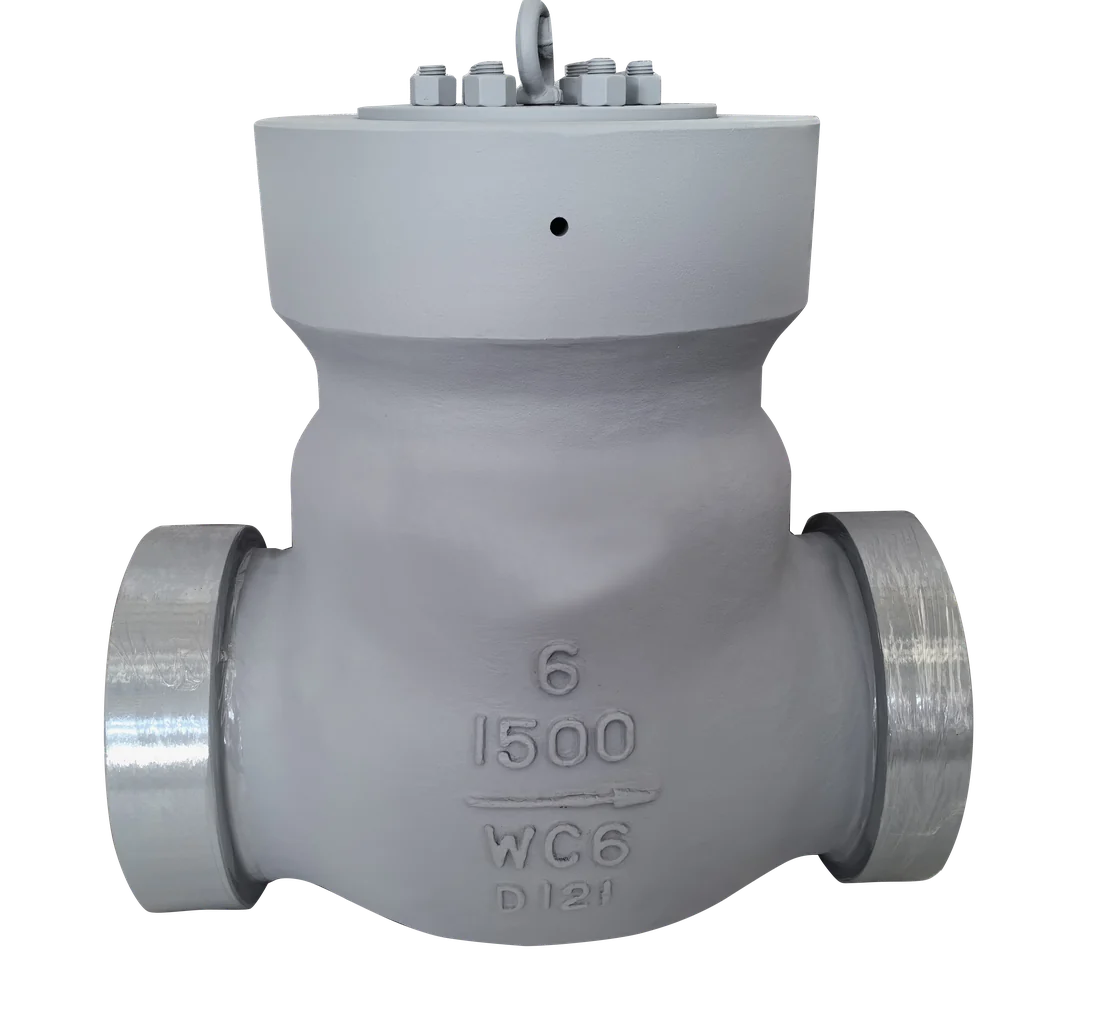
Pressure Seal Check Valve
Non-return valve with a self-energizing cover joint. Swing type for low-loss service, piston lift type where fast closure and stability matter more than pressure drop.
- Size
- NPS 2-24 (DN 50-600)
- Pressure class
- Class 600 - 4500
- Body material
- A105, A182 F11, F22, F91, F92
- End connection
- BW to ASME B16.25, SW, flanged RF or RTJ
Catalogue ranges for initial selection. Final rating and configuration are confirmed against your project specification.
Have an MTO or datasheet? Send it with size, class, material, quantity and required delivery.
01 / Selection data
Technical specifications
Use these ranges to shortlist the valve. Values marked “confirm per order” depend on the selected size, material or project standard.
Swipe or scroll sideways to view the full table.
| Parameter | Specification | Basis |
|---|---|---|
| Size | NPS 2-24 (DN 50-600) | Catalogue range |
| Pressure class | Class 600 - 4500 | Catalogue range |
| Design temperature | up to 650 °C / 1200 °F | Configuration dependent |
| Type | Swing check, piston lift check, tilting disc on request | Catalogue range |
| Medium | Superheated steam, saturated steam, feedwater, condensate | Catalogue range |
| Body material | A105, A182 F11, F22, F91, F92 | Catalogue range |
| Trim material | 13Cr / F6a, hardfaced with Stellite 6 | Catalogue range |
| Hinge pin | Hardened, renewable, retained outside the flow path | Catalogue range |
| Installation | Horizontal line, cover up (swing); vertical upward flow (lift)Other orientations need confirmation - some require a counterweight or a different disc. | Confirm per order |
| End connection | BW to ASME B16.25, SW, flanged RF or RTJ | Catalogue range |
| Minimum lifting velocity | Application-specificDepends on disc mass, medium density and orientation. Ask us to calculate it for your line size and flow. | Confirm per order |
02 / Engineering
Valve design & materials
Renewable hinge pin and bushings
The hinge pin runs in hardfaced bushings and is retained so it can be withdrawn without machining the body. The pin, arm and bushings are the wear parts in a swing check and they are specified as replaceable rather than as part of the body.
Full-open disc clearance
The body cavity is machined so the disc reaches the fully open position clear of the flow, rather than sitting partly in the stream where it flutters. This is what keeps head loss low and stops the hinge pin wearing prematurely.
Pressure seal cover
The cover uses the same self-energizing arrangement as the gate and globe valves. On a check valve this matters more than usual, because there is no stem and the cover joint is the only dynamic seal on the pressure boundary.
Piston lift alternative
Where reverse flow must be stopped quickly, a piston lift disc guided over its full stroke closes faster and is more stable in pulsating flow. It costs more pressure drop. We will tell you which one your duty points to rather than defaulting to whichever is cheaper.
Optional counterweight and damper
External lever with counterweight, or a hydraulic damper, where the closure characteristic has to be tuned. This is supplied against a stated closure requirement, not offered as a generic upgrade.
Reference material configurations
Material combinations are examples for selection; the final bill of materials is agreed for each order.
Swipe or scroll sideways to view the full table.
| Part | Carbon steel | Alloy steel | F91 / F92 |
|---|---|---|---|
| Body | A105 / A105N | A182 F11, F22 | A182 F91, F92 |
| Seat ring | 13Cr + Stellite 6 | 13Cr + Stellite 6 | F91 + Stellite 6 |
| Disc | A105 + Stellite 6 | F11 / F22 + Stellite 6 | F91 + Stellite 6 |
| Hinge arm | A182 F6a | A182 F6a | A182 F6NM |
| Hinge pin | A182 F6a, hardened | A182 F6a, hardened | A182 F6NM / Inconel 718 |
| Bushing | Stellite 6 / hardfaced | Stellite 6 / hardfaced | Stellite 6 / hardfaced |
| Cover (bonnet) | A105 / A105N | A182 F11, F22 | A182 F91, F92 |
| Pressure seal ring | Flexible graphite + SS liner | Flexible graphite + SS liner | Flexible graphite + Inconel liner |
| Thrust ring (segmental) | A105 | A182 F11 / F22 | A182 F91 |
| Retainer segments | A105 | A182 F11 / F22 | A182 F91 |
| Cover plug / vent | A105 | A182 F11 / F22 | A182 F91 |
| Nameplate | AISI 304 | AISI 304 | AISI 304 |
Service fit
Where this valve is used
Typical applications
- Boiler feedwater pump discharge
- Main steam and reheat lines to the turbine
- Extraction steam lines to feedwater heaters
- Auxiliary steam headers
- HP heater drain lines
Selection limits to check
- Positive isolation - a check valve is not a shut-off valve and must not be used as one. Pair it with a gate or globe valve.
- Pulsating flow near the disc-lifting velocity, which causes disc flutter and seat wear. A piston lift or nozzle type may be needed instead.
- Vertical downward flow on a swing check. Orientation must be stated at enquiry, not assumed.
- Systems where non-slam closure is a stated requirement without a documented closure analysis - that is an engineered selection, not a catalogue pick.
Quality assurance
Inspection & delivery documents
The inspection and test plan defines the agreed scope, hold points and witness points for your order.
Inspection scope
- Hydrostatic shell test to API 598 / MSS SP-61
- Hydrostatic or pneumatic seat test, leakage rate per specification
- Back seat test (gate and globe, where a back seat is supplied)
- PMI on all pressure-containing parts and welded overlays
- NDE per specification - RT, UT, MT or PT as applicable
- Hardness survey after post-weld heat treatment
- Dimensional inspection against approved GA drawing
- Material certification EN 10204 3.1 (3.2 on request)
- Visual and functional check, full stroke on the manual operator
- Disc seating check and free-swing verification through the full stroke
- Hinge pin clearance record before final assembly
Document package
- Product datasheet
- General arrangement (GA) drawing
- Inspection & Test Plan (ITP)
- Material test certificate (MTC) EN 10204 3.1
- Hydrostatic and seat test report
- PMI report
- NDE reports as applicable
- Heat treatment charts
- Dimensional report
- Packing list and preservation record
Reference framework
Applicable standards
Pressure-temperature ratings, materials, wall thickness, testing and marking. This is the base rating standard for the valve - it is what fixes the allowable pressure at your design temperature.
Face-to-face and end-to-end dimensions. Relevant when the valve replaces an existing one or has to drop into a fixed spool.
Butt welding end preparation, including bore and bevel geometry for the matching pipe schedule.
Applies to check valves - but note it covers wafer, dual plate and lift check types. Whether it applies to your specific check valve construction must be confirmed against the actual design, not assumed.
Inspection and pressure testing - which tests are mandatory, test durations and allowable leakage. We state the shell and seat test scheme on the ITP.
Marking of the body and the nameplate - size, class, material heat, figure number and flow direction where applicable.
Buying questions
Frequently asked questions
Swing or piston lift - how do I choose?
Swing check for steady flow where pressure drop matters, typically main steam and larger feedwater lines. Piston lift where flow reverses quickly or pulsates, and where the downstream equipment cannot tolerate a slug of reverse flow - pump discharge on parallel pumps is the classic case. Send us the line size, flow rate, medium and whether pumps run in parallel.
Can a swing check be installed in a vertical line?
In vertical upward flow, yes, with the correct disc and sometimes a spring or counterweight. In vertical downward flow, a standard swing check will not seat reliably under gravity. Tell us the orientation at enquiry - it changes the design, not just the tag.
Do you provide a non-slam closure analysis?
We provide the disc mass, geometry and closure characteristics needed for a surge analysis. The system-level surge calculation depends on pump inertia and line dynamics that only the project engineer has. We will not claim non-slam performance without that input.
What causes a check valve to fail in steam service?
In our experience the common ones are: disc flutter from sizing the valve for the line rather than the flow, hinge pin wear from continuous partial lift, seat erosion from wet steam, and installation in an orientation the valve was not designed for. Four of the five are selection and installation issues, not manufacturing ones.