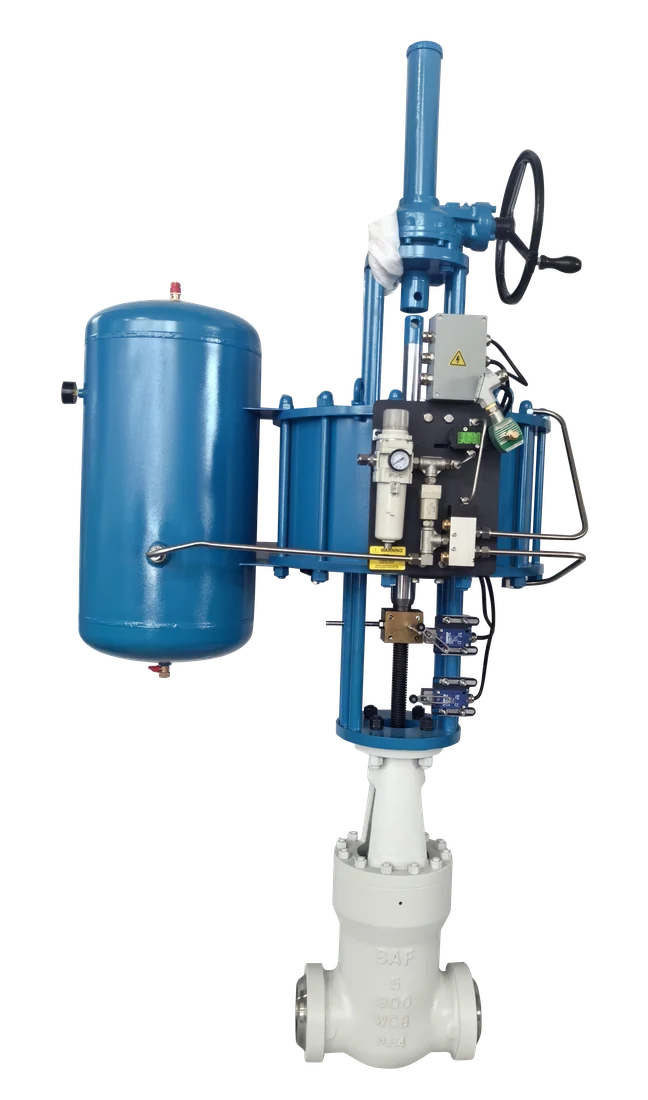
Pressure Seal Gate Valve
gate · pressure seal bonnet
- Size
- NPS 2-24 (DN 50-600)
- Class
- Class 600 - 4500
- Temp
- up to 650 °C / 1200 °F
A conventional thermal unit has perhaps a dozen distinct valve duties. Getting them right starts with knowing which system you are in and what governs there.
| Parameter | Value | Basis |
|---|---|---|
| Main steam pressure | 17-31 MPa (subcritical to USC) | typical |
| Main steam temperature | 540-610 °C | typical |
| Reheat temperature | 540-620 °C at lower pressure | typical |
| Feedwater pressure | Above drum pressure - often the highest in the plant | typical |
| Feedwater temperature | 150-300 °C | typical |
| Start-stop cycles | Rising sharply on units now two-shifting | per project |
Above roughly 540 °C the governing property is creep rupture strength, and F22 falls away quickly. F91 and F92 exist because of this, and a Class 2500 valve in the wrong grade will meet its hydro test and fail years later. Get the design temperature and the grade agreed before anything else - valve type is the easier question.
Feedwater is frequently a higher pressure class than main steam, because the feed pump must overcome drum pressure plus static head plus system losses. Temperature is moderate, so creep is not the issue - cavitation, flashing and check valve dynamics are.
Extraction check valves exist to stop reverse steam from the feedwater heaters spinning the turbine up after a trip. Selection follows the turbine protection study. Power-assisted closure is common on the larger extractions and rare on the small ones.
These positions see wet steam, flashing and frequent operation, and they are usually specified last and cheapest. Hardfaced globe valves handle them; a gate valve throttled to control a drain will not last.
Units designed for base load and now two-shifting see far more thermal cycles than the original design assumed. This is where flexible wedges, pressure seal bonnets and correct PWHT stop being nice-to-have and start being the difference between a valve that lasts and one that does not.
Indicative only. The grade is set by the piping class and the ASME B16.34 rating at your design temperature - see the material matrix.
gate · pressure seal bonnet
The thick-section, high-class, thermally cycled ones - main steam, reheat and high-pressure feedwater above Class 900. Below that, and on large-bore low-pressure duties, a properly inspected casting is the appropriate answer. Your piping specification usually settles it; where it does not, the duty should.
For the high-energy systems, typically four constructions: pressure seal gate, pressure seal globe, check, and stop-check. Everything else is variation in size, class and material. Consolidating on fewer constructions across the plant simplifies spares more than it costs in optimisation.
Send the system conditions and we will come back with what we would supply, the rating basis, and any point where we would question the specification.