Frequently asked questions
Grouped by what stage of the job you are at. Several of these answers point out where our own site is incomplete - that is intentional.
Selection
How do I know whether I need a pressure seal bonnet?
Above Class 900 it is effectively standard, because bolt load alone cannot hold a gasketed joint through thermal cycling at those pressures. Below Class 600 there is normally no reason to specify one. Between the two, the deciding factor is usually how often the plant cycles.
Gate, globe or check - how do I decide?
Gate for full-bore isolation where pressure drop matters. Globe for throttling, drains and vents, and where tight shut-off is more important than flow area. Check for non-return only - never as an isolation valve. Stop-check where you need isolation and non-return in one body.
Is Class 2500 safer than Class 1500?
No. It is heavier, more expensive, longer lead time, and on a cycling plant the thicker sections actually behave worse during thermal transients. Select the class from the design condition against the ASME B16.34 rating table for your material. The margin is already in the table.
Can I use a gate valve for throttling?
No. A partly open wedge in flashing or high-velocity flow erodes quickly and unevenly, and the valve you have damaged is the one you were relying on for isolation. Use a globe valve, or a control valve if the duty is continuous modulation.
Materials and standards
F22 or F91?
Design temperature decides. F22 is fine to around 540 °C; above that its allowable stress falls away and F91 or F92 is needed. But the piping class usually decides for you, because the valve should match the pipe it welds into.
Why do you list API 600 on some valves and not others?
Because API 600 is written for bolted bonnet gate valves. Listing it on a pressure seal valve is common on supplier websites and it is wrong. We list it only where it applies.
Are your valves ISO 15848 certified?
Not as a blanket claim. A fugitive emission type test qualifies a specific design within a stated size, class and temperature envelope. If your specification requires it, tell us at enquiry and we will state whether the qualification exists for that design or would need to be obtained.
What does "integral forged" mean on your datasheets?
It means a specific feature - a seat or an end connection - is formed as part of the body forging rather than welded on. It is not a synonym for "one-piece forged", which means the pressure-containing body is machined from a single forging. Many suppliers use them interchangeably; we do not.
Ordering and inspection
What do you need to quote?
Nine data points: medium, design pressure, design temperature, class, size, material, end connection, operator and the document requirements. The RFQ checklist explains why each one changes the answer.
Can I send a valve list instead of individual enquiries?
Please do - it is the most efficient form of enquiry. You get a line-by-line response with a comment against each item, including the lines where we would need a deviation and the lines where we think the wrong valve has been specified.
Do you accept third-party inspection?
Yes. Send your ITP with the enquiry and we mark up which points we accept as hold, witness or review. Agreeing this before the order avoids schedule loss later.
What is your lead time?
Driven by forging availability and heat treatment, not machining. We quote a date against actual forging supply at the time of enquiry rather than a standard catalogue figure, which for a range this wide would be meaningless.
Can you match an obsolete valve for a replacement?
Often. Send the nameplate photograph, the figure number if legible, and the face-to-face dimension. Standard B16.10 face-to-face makes most replacements straightforward. A non-standard original does not, and we will say so rather than promise a fit we cannot confirm.
About this website
Why does the certificates page list nothing?
Because nothing has been verified for publication yet. Certification claims are the easiest thing on a supplier website to assert and the most damaging to assert wrongly. They will be listed with issuing body, number and validity, verifiable against the certification body register.
Why are some parameters marked "per project"?
Because they genuinely cannot be stated without your specification. A closure time for a check valve, a leakage class, a maximum temperature - these depend on your system. Publishing a single number for them would be a marketing figure, not an engineering one.
Why are some pages without photographs?
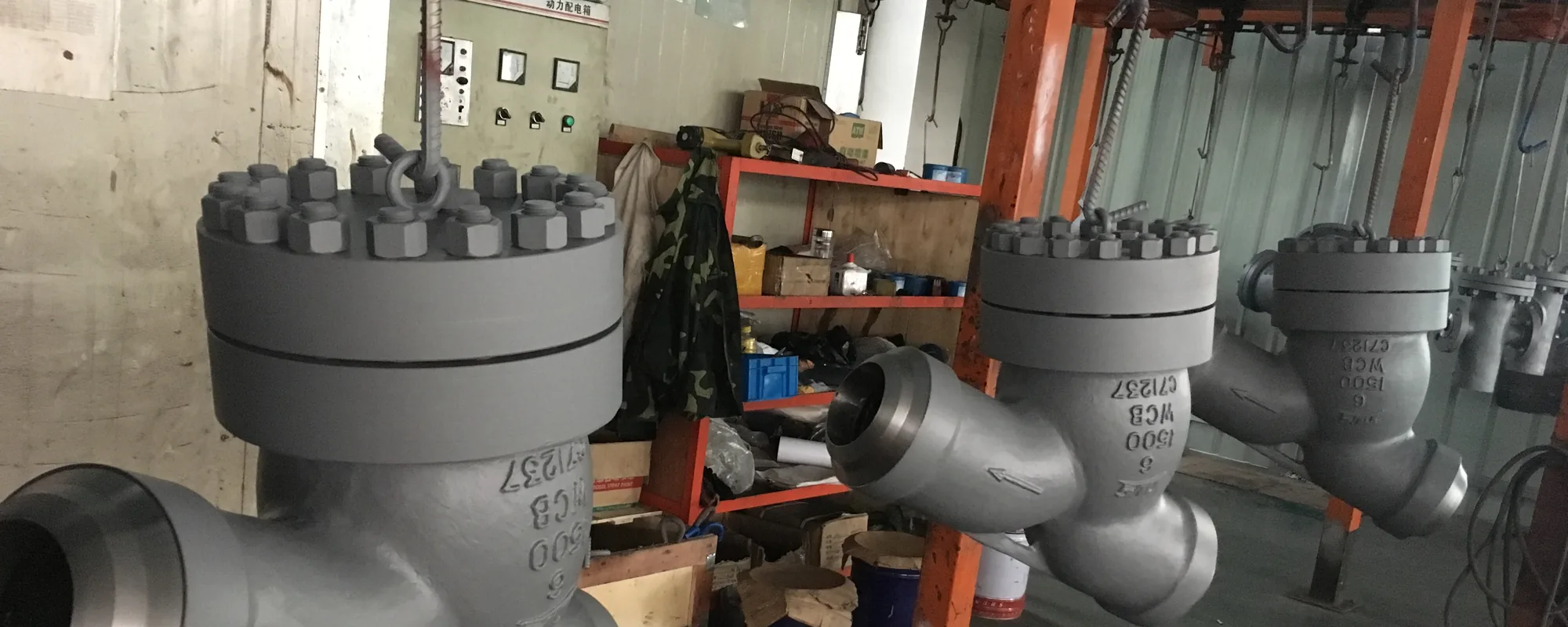
Every photograph here was taken by us: at our works, during inspection of a real order, or at a project site. Photographs of plant, production and inspection come from our own shop and our own orders, and where we do not have one for a stage yet the page goes without rather than using stock imagery. The application pages carry site photographs - a power plant pipe rack, refinery process units - showing the service these valves are selected for. Nothing on this site is a stock image, an AI-generated image, or a render presented as a real one.
Not answered here?
Technical questions get a technical answer, including "we do not know" and "that is outside what we do" where those are the correct answers.