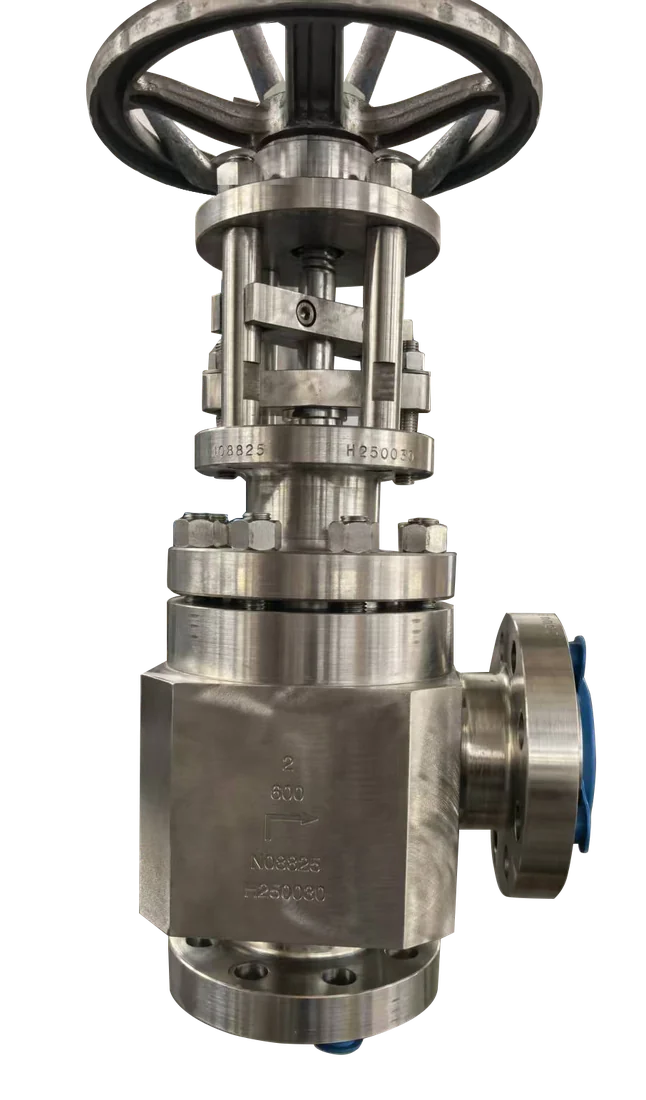
Dervos valve · Product specification
Forged Globe Valve
Globe valve with a one-piece forged pressure boundary. The construction of choice where the valve throttles and cycles at high pressure.
- Size
- NPS 2 - 16 (DN 50-400)
- Pressure class
- Class 900 - 4500
- Body material
- A105, A182 F11, F22, F91, F92, F347
- End connection
- BW to ASME B16.25, SW, flanged RTJ
Catalogue ranges for initial selection. Final rating and configuration are confirmed against your project specification.
Have an MTO or datasheet? Send it with size, class, material, quantity and required delivery.
01 / Selection data
Technical specifications
Use these ranges to shortlist the valve. Values marked “confirm per order” depend on the selected size, material or project standard.
Swipe or scroll sideways to view the full table.
| Parameter | Specification | Basis |
|---|---|---|
| Size | NPS 2 - 16 (DN 50-400) | Catalogue range |
| Pressure class | Class 900 - 4500 | Catalogue range |
| Design temperature | up to 650 °C / 1200 °FSet by the body grade and the ASME B16.34 rating table. | Configuration dependent |
| Body construction | One-piece integral forged pressure boundary | Catalogue range |
| Bonnet | Self-energising pressure seal | Catalogue range |
| Pattern | Straight, Y-pattern and angle | Catalogue range |
| Medium | Superheated steam, wet steam, feedwater, condensate | Catalogue range |
| Body material | A105, A182 F11, F22, F91, F92, F347 | Catalogue range |
| Trim material | F6a / F6NM, two-layer Stellite 6 hardfaced | Catalogue range |
| Disc | Plug type; anti-erosion profile on high differential duty | Confirm per order |
| End connection | BW to ASME B16.25, SW, flanged RTJ | Catalogue range |
02 / Engineering
Valve design & materials
Forged boundary on a fatigue duty
Drain and bypass positions cycle far more than isolation valves. A forged body without casting defects has fewer initiation sites where the thermal gradient is steepest.
Pattern follows the pressure drop
Y-pattern where head loss matters, angle where it deletes an elbow, straight where neither applies. We propose one and give the reason.
Two-layer Stellite 6
Applied in two layers so the finished seating surface is not diluted by the parent metal, then machined to profile.
Anti-erosion trim option
Where the duty is wet steam or high differential pressure, the answer is where the energy is dissipated, not simply a harder overlay on the same profile.
Live-loaded gland
Belleville stacks hold packing load through the cycle count these positions actually see.
Reference material configurations
Material combinations are examples for selection; the final bill of materials is agreed for each order.
Swipe or scroll sideways to view the full table.
| Part | Carbon steel | Alloy steel | F91 / F92 |
|---|---|---|---|
| Body | A105 / A105N | A182 F11, F22 | A182 F91, F92 |
| Seat ring | 13Cr + Stellite 6 | 13Cr + Stellite 6 | F91 + Stellite 6 |
| Disc (plug type) | A105 + Stellite 6 | F11 / F22 + Stellite 6 | F91 + Stellite 6 |
| Disc nut / stem coupling | A182 F6a | A182 F6a | A182 F6NM |
| Stem | A182 F6a | A182 F6a Cl.2 | A182 F6NM / 422SS |
| Bonnet | A105 / A105N | A182 F11, F22 | A182 F91, F92 |
| Pressure seal ring | Flexible graphite + SS liner | Flexible graphite + SS liner | Flexible graphite + Inconel liner |
| Thrust ring (segmental) | A105 | A182 F11 / F22 | A182 F91 |
| Retainer segments | A105 | A182 F11 / F22 | A182 F91 |
| Gland | A105 | A182 F11 / F22 | A182 F91 |
| Stem packing | Flexible graphite | Flexible graphite | Flexible graphite, low-leakage set |
| Yoke / yoke bushing | WCB / Ni-Al bronze | WCB / Ni-Al bronze | WCB / Ni-Al bronze |
| Back seat | 13Cr overlay | 13Cr overlay | Stellite overlay |
| Handwheel | Ductile iron / carbon steel | Ductile iron / carbon steel | Ductile iron / carbon steel |
| Nameplate | AISI 304 | AISI 304 | AISI 304 |
03 / Reference dimensions
Dimensions & approximate weight
Typical reference values only. Request the approved GA drawing and confirmed weight for your selected class and configuration.
Swipe or scroll sideways to view the full table.
| NPS | DN | Face to face / end to end | Approx. weight |
|---|---|---|---|
| NPS 2 | DN 50 | 368 mm | ~60 kg |
| NPS 3 | DN 80 | 470 mm | ~115 kg |
| NPS 4 | DN 100 | 546 mm | ~195 kg |
| NPS 6 | DN 150 | 705 mm | ~420 kg |
| NPS 8 | DN 200 | 832 mm | ~760 kg |
| NPS 10 | DN 250 | 991 mm | ~1240 kg |
| NPS 12 | DN 300 | 1130 mm | ~1900 kg |
Service fit
Where this valve is used
Typical applications
- High-pressure drains and continuous blowdown
- Main steam warm-up and bypass
- Startup vent lines
- Turbine bypass and pressure-reducing stations
- Severe service positions with high differential pressure
Selection limits to check
- Full-bore isolation. The flow path costs head even wide open; use a gate valve.
- Modulating control. This tolerates throttling, it is not trim designed to a flow characteristic.
- Lines to be pigged.
- Reverse flow. Direction is marked on the body and is not a preference.
Quality assurance
Inspection & delivery documents
The inspection and test plan defines the agreed scope, hold points and witness points for your order.
Inspection scope
- Hydrostatic shell test to API 598 / MSS SP-61
- Hydrostatic or pneumatic seat test, leakage rate per specification
- Back seat test (gate and globe, where a back seat is supplied)
- PMI on all pressure-containing parts and welded overlays
- NDE per specification - RT, UT, MT or PT as applicable
- Hardness survey after post-weld heat treatment
- Dimensional inspection against approved GA drawing
- Material certification EN 10204 3.1 (3.2 on request)
- Visual and functional check, full stroke on the manual operator
Document package
- Product datasheet
- General arrangement (GA) drawing
- Inspection & Test Plan (ITP)
- Material test certificate (MTC) EN 10204 3.1
- Hydrostatic and seat test report
- PMI report
- NDE reports as applicable
- Heat treatment charts
- Dimensional report
- Packing list and preservation record
Reference framework
Applicable standards
Pressure-temperature ratings, materials, wall thickness, testing and marking. This is the base rating standard for the valve - it is what fixes the allowable pressure at your design temperature.
Face-to-face and end-to-end dimensions. Relevant when the valve replaces an existing one or has to drop into a fixed spool.
Butt welding end preparation, including bore and bevel geometry for the matching pipe schedule.
Inspection and pressure testing - which tests are mandatory, test durations and allowable leakage. We state the shell and seat test scheme on the ITP.
Alternative pressure testing scheme for steel valves, used where the project specification calls for it instead of API 598.
Marking of the body and the nameplate - size, class, material heat, figure number and flow direction where applicable.
Buying questions
Frequently asked questions
Why forge a globe valve rather than cast it?
Because of what the duty is, not what the valve is. Drains and bypasses cycle frequently at full differential pressure, which makes fatigue and erosion the governing mechanisms. That is where casting porosity and as-solidified structure cost you life.
What do you need to quote an anti-erosion configuration?
The medium including moisture and any entrained solids, the differential pressure when the valve is throttling, and the expected cycle count. Without those, an anti-erosion claim is a word rather than a design.
Do you supply these as pressure-reducing stations?
We supply the valves. Sizing a reducing station is a system engineering exercise involving the downstream case and often desuperheating, and we will say where the boundary of our scope is rather than imply we cover it.